©BabbaroHouse

BIRDS
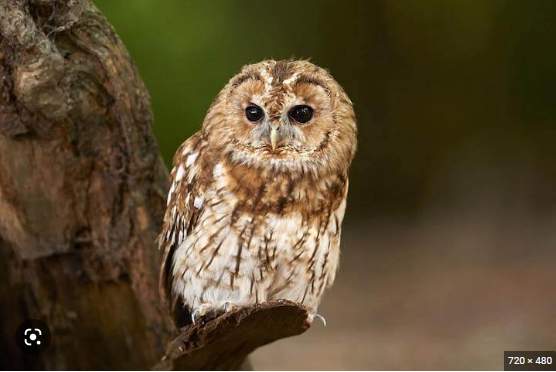
Tawny owl
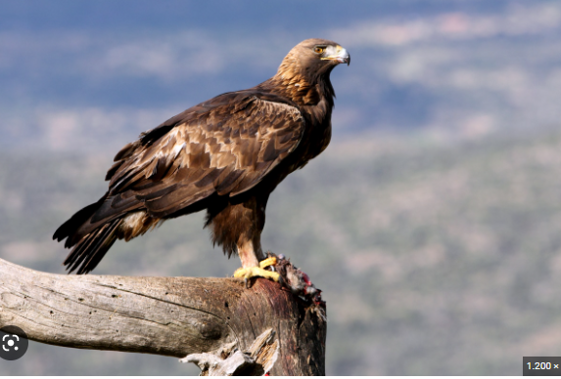
Golden eagle
With predominantly nocturnal habits, it also allows itself excursions during the daytime hours. Its movements are very slow and heavy, but its flight is light, swaying, but not fast.
The tawny owl (Strix aluco) is 38 cm long, has a brown coat densely speckled, a large and rounded head, and black eyes.
The beak is robust and curved, the legs are sturdy and covered with feathers, the claws are long and sharp, and the fourth toe, opposite the others, is equipped with a longer claw that pierces the prey. It has extraordinary eyesight, six times sharper than that of humans and a field of vision of 300 degrees.
The plumage is all dark brown with golden feathers on the head which, resembling a crown, have earned it the title of "royal." Young specimens have white spots under the wings and at the base of the tail.
The golden eagle (Aquila chrysaetos) reaches a length that can vary between 75 and 88 cm, its wingspan can reach 2.30 meters, while its weight can reach up to 6.7 kg. The largest sizes, as in almost all birds of prey, are found in females.
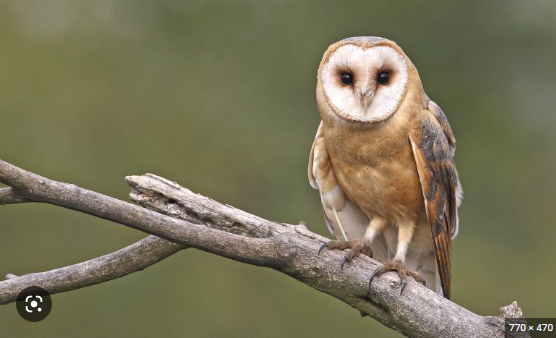
Barn Owl
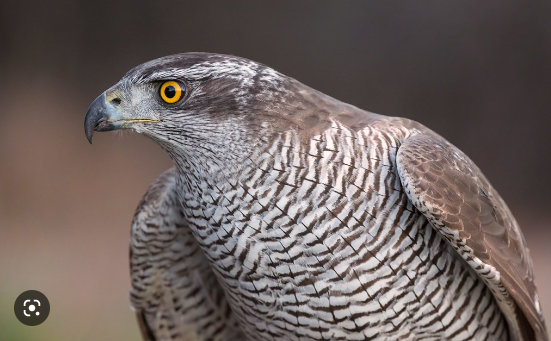
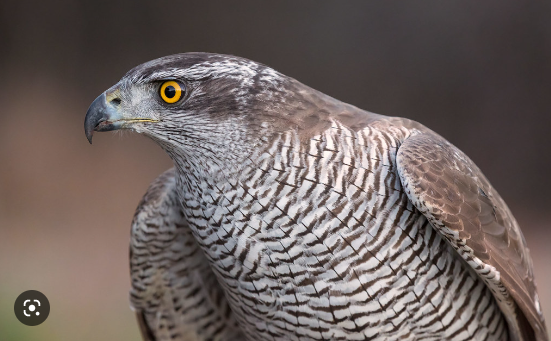
Goshawk
In females, usually larger in size, the colors are darker.
It is a sedentary bird in the truest sense of the word, and generally does not even undertake short excursions. It has no enemies and does not fear humans.
At night it crosses the countryside with an undulating and light flight close to the ground. When it flies it emits a hoarse and unpleasant cry. COMPLETE FACT SHEET >>
The barn owl (Tyto alba) reaches a length between 34 and 40 cm and a wingspan of almost one meter. It is characterized by a heart-shaped facial disc and ears without tufts. The upper parts are tawny-golden spotted with black and white, while the lower parts are white or tawny. The large heart-shaped facial disc is also white, while the eyes are black and the beak is whitish-pink.
.
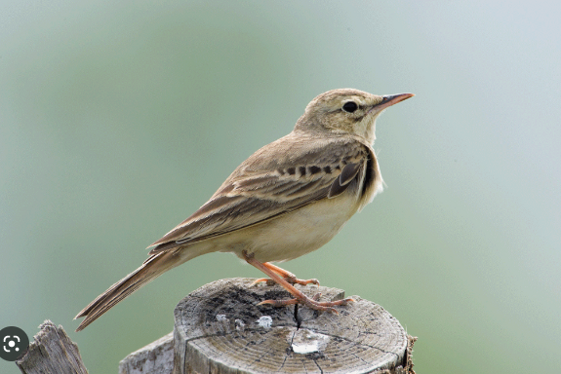
Calandro
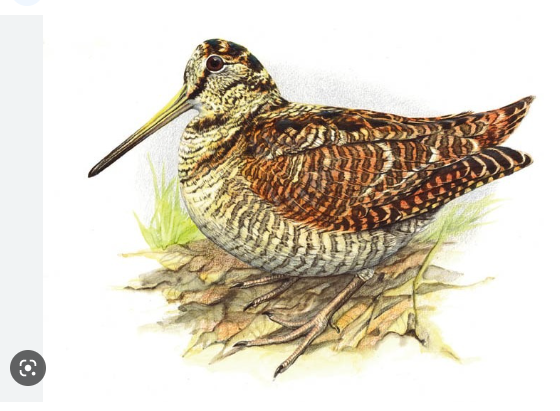
Woodcock
In its movements, the tawny pipit resembles larks; in fact, it runs keeping its body almost horizontal and rhythmically raises and lowers its tail, and from time to time it stops on a clod or a higher stone to observe what is happening around it.
During flight, it spreads its wings and then suddenly folds them, thus gaining remarkable speed. In the air, it traces a serpentine line and then suddenly descends to the ground in a vertical trajectory.
It is a shy and cautious bird, its song, very simple, resembles that of the skylark. COMPLETE SHEET >>
The tawny pipit is about 18 cm long and has a slender body, its plumage is sand-colored with brown spots, while its belly is lighter in color. The eyebrows are cream-colored and very prominent.
It has a creeping gait, as it walks with short steps and a curved back, and is slow. If it needs to travel long distances, it always resorts to flying, in which it is extremely agile.
The woodcock is very cunning and has very acute senses; it often uses the camouflaged color of its plumage to hide, crouching against the ground at the slightest sign of danger.
During the day it never goes outdoors and only at dusk does it become active, starting to rummage among the leaves in search of food.
Formidable enemies of woodcocks, in addition to birds of prey, are hunters who slaughter them during the migration period; in Italy in particular, it is among the most coveted game. COMPLETE FACT SHEET >>
The woodcock (Scolopax rusticola) measures up to 34 cm in length and has dead leaf-colored plumage, with black transverse bars on the head and neck. The eyes are large and set far back on the round head, allowing it a field of vision of almost 360 degrees. The beak is 6 to 8 cm long, sturdy, and rounded at the tip. The legs are rather short and covered with feathers up to the heel. Hearing is particularly developed, and the ear cavities are located, instead of behind the eyes as in all birds, below and a bit in front of them, and are protected by feathers.
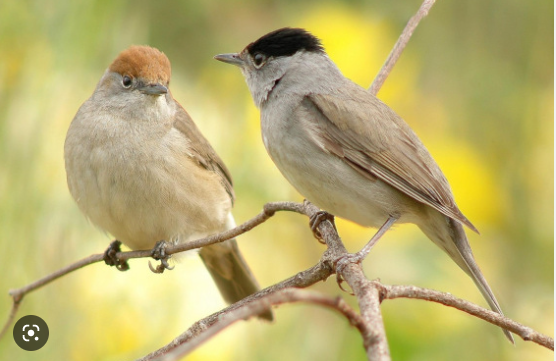
Blackcap
Goldfinch
In autumn, the young male also shows brownish shades on the crown. Juveniles have more tawny upperparts and more yellowish underparts. It differs from the Garden Warbler and the Sardinian Warbler by the very well-defined 'cap', which reaches up to the eye, and also by the absence of any white patch on the tail feathers. The female can be distinguished from the Garden Warbler by the color of the crown.
It is a lively, timid, sociable, and gentle bird, often staying among the foliage of trees and bushes, less reclusive than the Garden Warbler. It is rare to see it hopping on the ground with very bent legs. The flight is generally short and undulating.
The Blackcap's song begins with spring and is emitted softly; as the breeding season approaches, it increases in intensity until it reaches full sonority. The interpretation varies from individual to individual. The call contains a harsh, grumbling note: a rapidly repeated tac-tac when alarmed, and also a harsh ciarrrr. Also an alarmed suiirr and a plaintive fiuu. The song is full of trills, much richer in phrases than that of the Garden Warbler, less sustained, but stronger towards the end.
COMPLETE FACT SHEET >>
The Blackcap (Sylvia atricapilla) is about 14 cm long, the male has a light ash-grey coloration with a black cap while the females are browner with a rusty red cap. The beak and legs are always dark. Albinism is rare: an albino specimen is preserved in the civic museum of La Spezia. It is not uncommon to see individuals with a yellow throat: this coloration is artificial, caused by the pollen of aloe flowers.
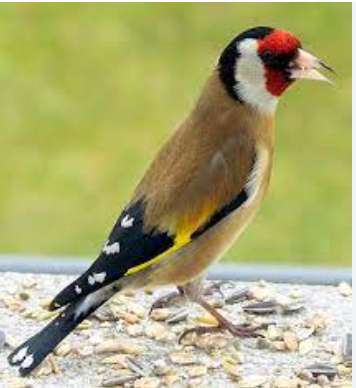
There are numerous varieties of the Goldfinch (Carduelis carduelis), which differ from each other by a slight variation in length and by very subtle color shades. In the most common variety, the male is about 14 cm long; the female, which is distinguished by slightly paler shades and by the black at the start of the shoulder veiled with gray, is a bit smaller.
The plumage, remarkable for its colors and even more for its truly sui generis pattern, appears as follows: crimson red facial mask bordered in black around the beak, as well as black on the middle and back parts of the head; temples and cheeks white; belly and center of the chest whitish-gray, shaded hazel on the sides; back hazel brown, rump slightly lighter; wings black barred with yellow, tail black with white spots. The beak is whitish pink with a blackish or bluish tip and becomes completely light during the breeding season. Brown legs.
Complete molt in August. September. Juveniles: upper parts brownish-gray; lower parts more whitish. Beak white-pink with black-brown tip; flesh-colored legs; dark brown iris.
The male, during courtship, tilts his body from side to side while keeping his wings open and rapidly oscillating them.
It is subject to epilepsy and in old age can become blind. COMPLETE FACT SHEET >>
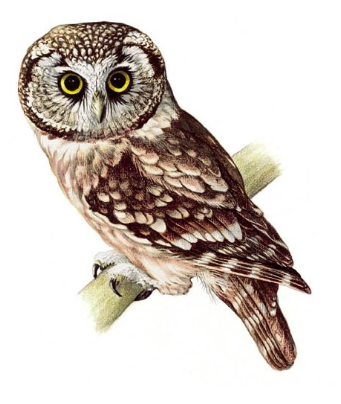
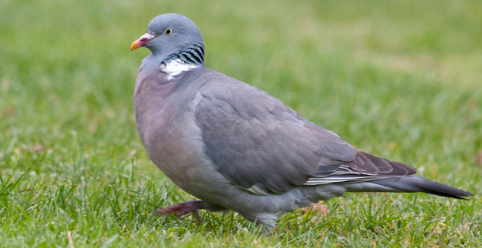
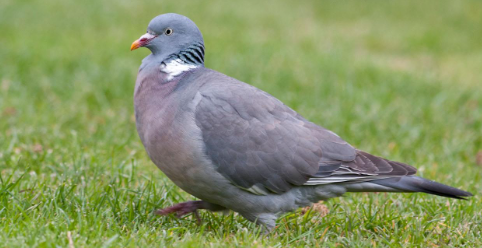
Woodpigeon
Owl
The female is slightly larger than the male
The short wings it is equipped with allow it to fly quickly but only in a straight line. When it lands it crouches but immediately straightens up if disturbed.
It is a cheerful and lively bird even during the day, it is not afraid of humans and never sleeps so deeply as to be caught off guard, the slightest noise wakes it up, and it can see perfectly well even during the day.
Enemies of the little owl are goshawks and sparrowhawks, which, if they manage to catch one, strangle it. The situation is different with the weasel, which eats its eggs.
COMPLETE FACT SHEET >>>
The little owl (Athene noctua) does not exceed 22 cm in length and has a wingspan of about 58 cm. It has a flattened head and fairly prominent facial discs with a whitish background color. The eyes are yellow, the plumage is brown above, barred and spotted with white, and white below with brown streaks.
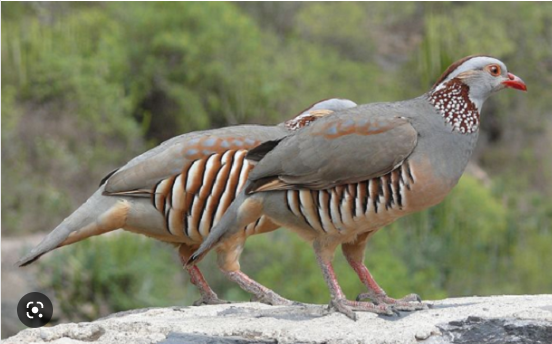
Apennine Rock Partridge
Imperial Raven
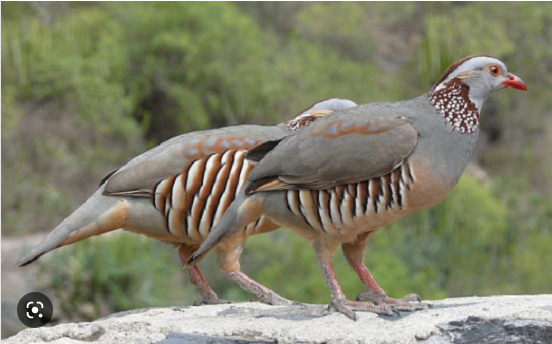
It has an elegant and almost straight flight, and the males, during the mating season, engage in fierce battles for the possession of the females.
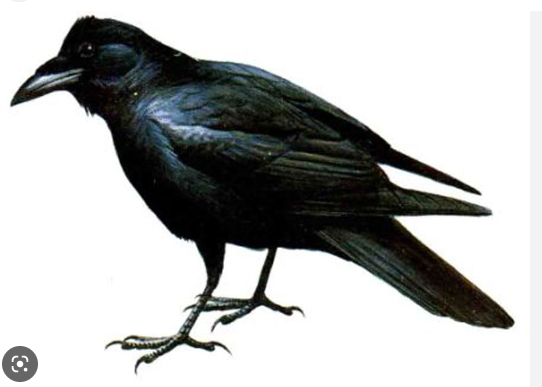
.The common raven (Corvus corax) is the largest passerine and crow in Europe, its wings span more than 1.3 meters in width and from beak to tail it measures between 62 and 70 cm. It reaches a weight of 1400 grams and has black plumage and a robust beak, the tail is wedge-shaped and the throat is shaggy. Its plumage is so smooth that the body appears fused into a single piece; in fact, the neck feathers stand up only when the bird is very excited.
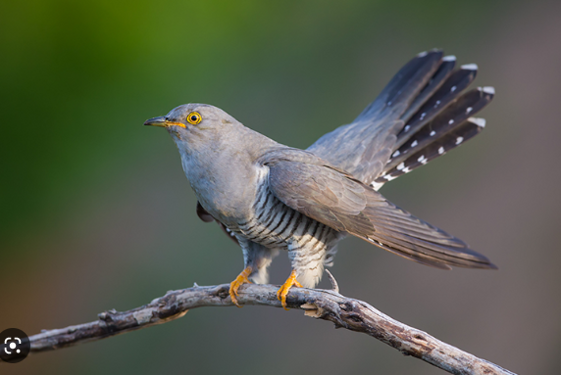
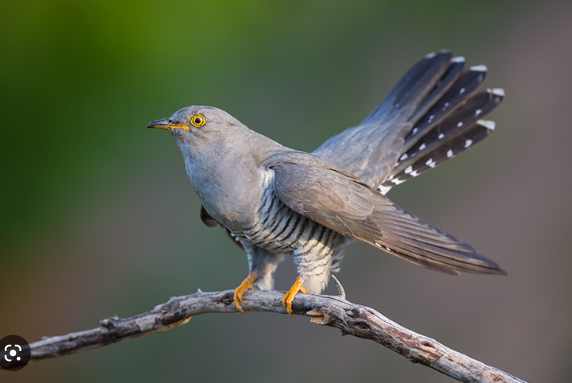
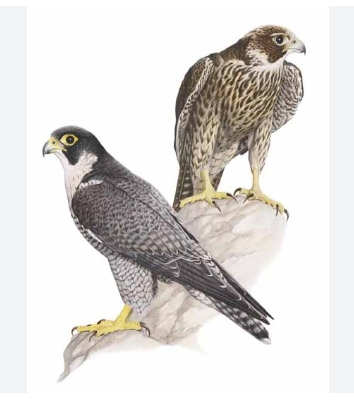
Cuckoo
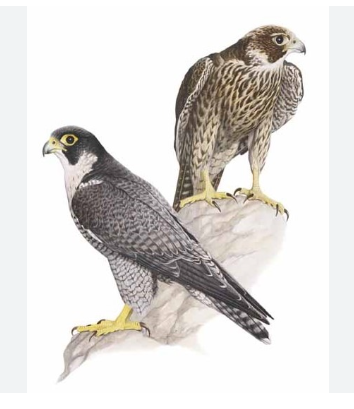
Peregrine Falcon
I
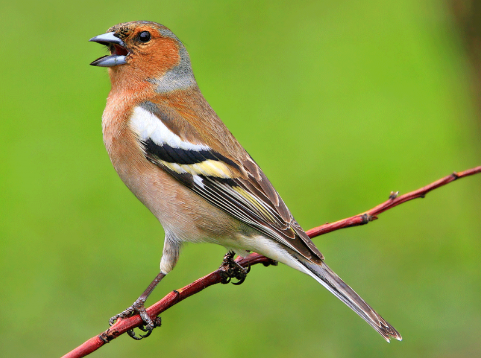
Chaffinch
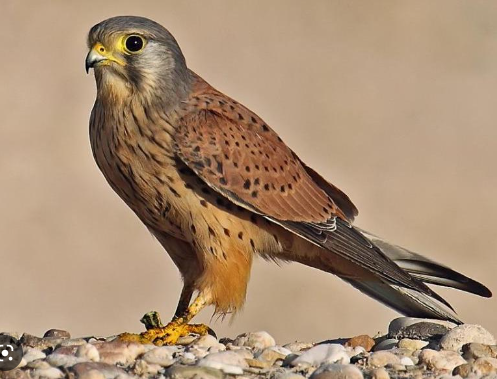
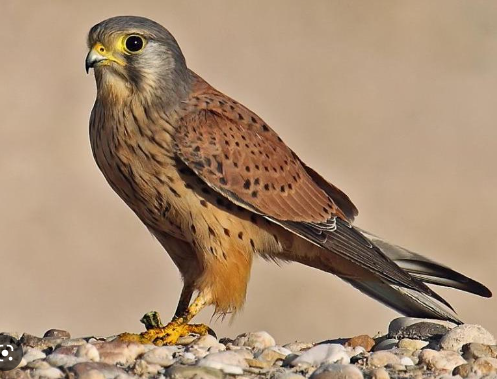
Kestrel
The female can be recognized by the upper parts of yellowish olive-brown color and the sides of the head and the lower parts of pale gray-brown, tending to whitish, lacking red. Young chaffinches are pigmented like the female, and also have whitish patches on the nape and a greenish-brown rump. The flight is undulating.
The chaffinch (Fringilla coelebs) can reach a length of 17 cm; it is characterized by a black forehead and the upper part of the head, the nape and sides of the neck bluish gray; the cheeks, sides of the head and neck, throat and chest are pinkish-wine; back and scapulars are chestnut brown, rump olive green; lower parts rusty white; wings black barred with white at the base with greenish outer edges; tail black, legs dark and beak brownish with a dark tip, pale blue from March to August. The eyes are brown and it undergoes a complete molt between July and October.
Red-billed Chough
It has a light and elegant flight and proves to be sociable even towards injured companions.
If something unusual or suspicious enters their range, the various individuals warn each other with sharp cries and sometimes, gathered in flocks, even attack birds of prey passing nearby. Among its worst enemies are the peregrine falcon, the goshawk, and the sparrowhawk, while the kestrel is limited to attacking the young still in the nest. The nestlings are sometimes also preyed upon by foxes and martens.
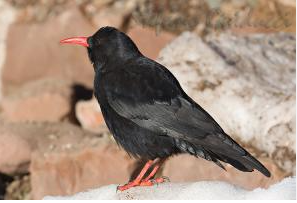
The red-billed chough (Pyrrhocorax pyrrhocorax) is about 40 cm long and has black, shiny, and glossy plumage with blue reflections, long legs. It has an elongated body with short wings and tail, the beak is sharp and slightly curved, often red in color.
Jay
It has a beak shorter than the head, rather thick and slightly hooked at the tip.
It is a restless bird, moving among the branches with remarkable agility, and is very afraid of birds of prey, which have no difficulty catching it when it is flying in open areas.
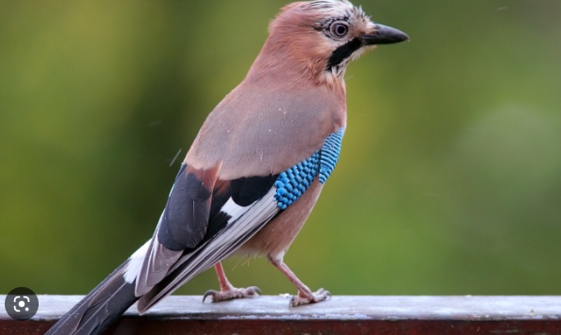
The jay (Garrulus glandarius), about 34 cm long, has a brownish-pink plumage with a black tail, black wings with a white and a blue patch, and long erectile feathers streaked with white and black on the head. Both the male and the female can reach a maximum weight of about 192 grams.
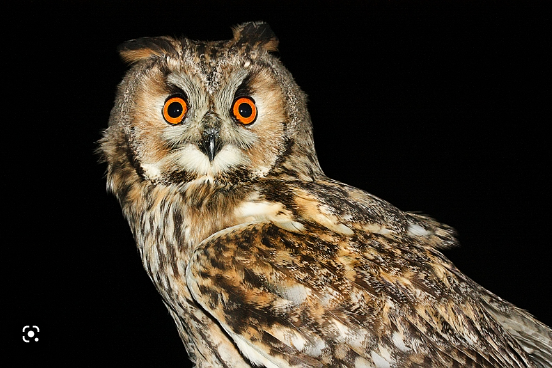
Eurasian eagle-owl
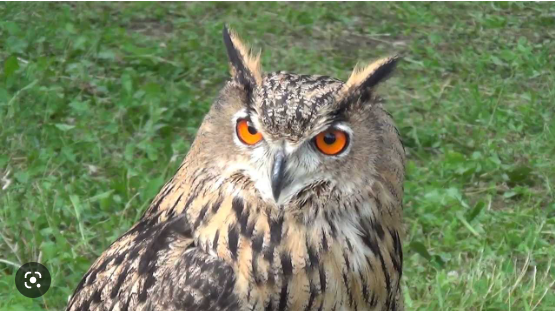
A typical feature of the Eurasian eagle-owl is the two tufts of erectable feathers above the ears.
It becomes sedentary in adulthood, while it is erratic during colder winters or at a young age.
>
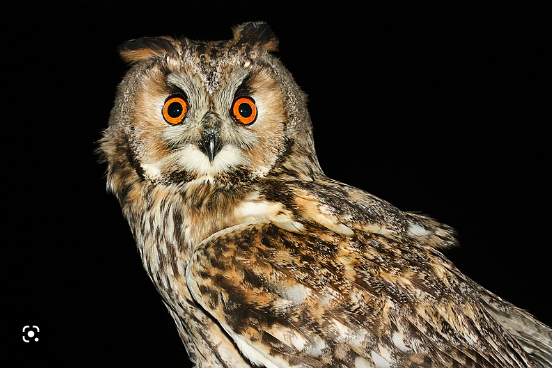
The Eurasian eagle-owl (Bubo bubo) reaches a length of 70 cm and a wingspan of 190 cm. It has very prominent ears and large golden-yellow eyes set in an incomplete facial disc; the plumage is tawny, darker on the back, mottled and streaked with brown.
Common owl
Int .

Kingfisher
It has an always fast and steady flight, which allows it to cut through the air in a straight line, keeping parallel to the level of the water and thus following the twists and turns of the river without ever moving away from the water.
Because of its small feet, it only hops on a few stones or posts, and never walks on the ground.
It is a not very sociable bird and lives alone, not tolerating any competitor in its hunting territory.
The kingfisher (Alcedo atthis) is 16/17 cm long, with a long beak, thick at the base, short wings and tail, and small feet. The upper parts are metallic blue-green, the underparts and cheeks are rusty yellow, and a white spot stands out on the sides of the neck.
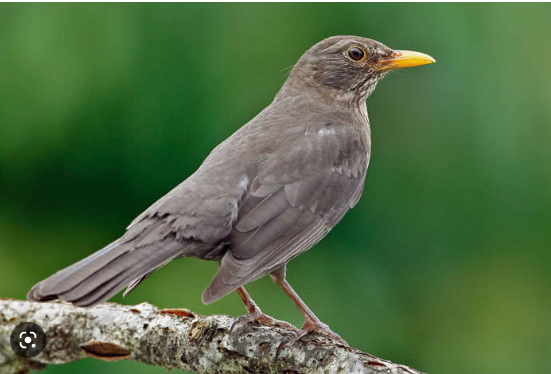
Merlo
The female has uniformly dark brown upperparts, brown-tawny underparts with more or less distinct dark streaks, a paler, whitish throat; brown beak with little yellow, rarely yellow like the male. Juveniles are lighter and more tawny than the female, with more evident streaks on the underparts.
The young male has a blackish beak and a browner mantle with dark brown legs. Older males are grayish, with a yellow beak.
Specimens with abnormal coloration are not rare: reddish, with white and black spots, or ashy. Albinos are rare, in which the beak, iris, and legs of a delicate pink color worthily complete the snowy coat. Partial albinos, on the other hand, are frequent and can be distinguished from the Ring Ouzel by the absence of the gray spot on the wings, as well as by the voice.
There is a second species called the Ring Ouzel (Turdus torquatus) which differs from the Common Blackbird by its larger size (it is about 27 cm long) and by a white band on the chest, broad in the male, reduced in the female. COMPLETE FACT SHEET >>
The blackbird (Turdus merula), about 25 cm long, is known for its beautiful, shiny, and uniform black plumage and for its bright orange-yellow beak and periophthalmic ring and brown legs. The plumage is soft and thick.
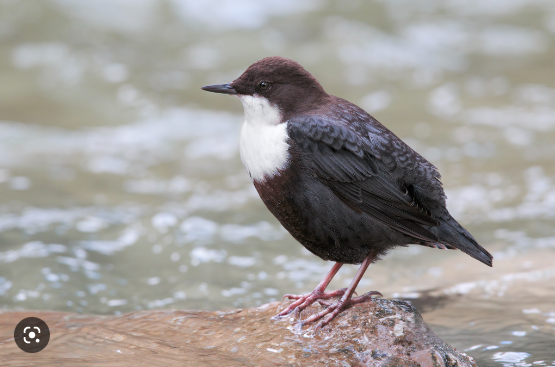
Dipper thrush
It possesses all senses highly developed, particularly sight and hearing. COMPLETE FACT SHEET >>
The white-throated dipper (Cinclus cinclus) is generally 17 cm long, with brown and dark grey plumage on the upper parts and belly, and white on the chest. In flight, it beats its wings rapidly and stays low over the water.
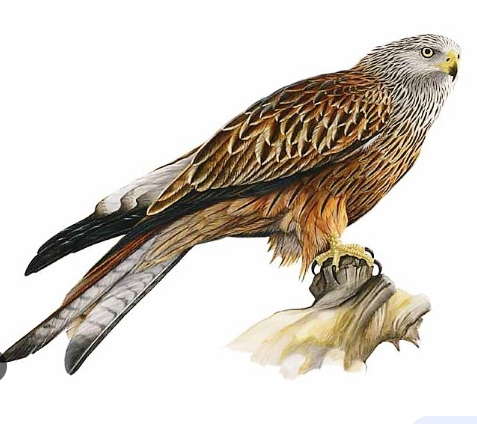
Red kite
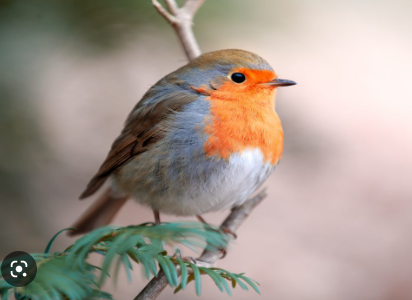
Robin
It reaches a maximum weight of 16 grams.
It is a bird of inexhaustible liveliness. On the ground it moves with a rapid succession of long hops, in an almost crouched position for a step or two, then stops in an upright posture, sometimes making its wings and tail quiver. If curious or excited, it quickly tilts its body from side to side, moving its wings and tail. The flight is usually slow and short. COMPLETE FACT SHEET >>
The robin (Erithacus rubecola) is 13 to 15 cm long and has a forehead, sides of the head, throat and chest that are orange-red. The upper parts are olive-brown while the abdomen is white; both the beak and legs are brown. There is no difference between males and females. Juveniles do not have the orange chest and show numerous dark brown and tawny spots.
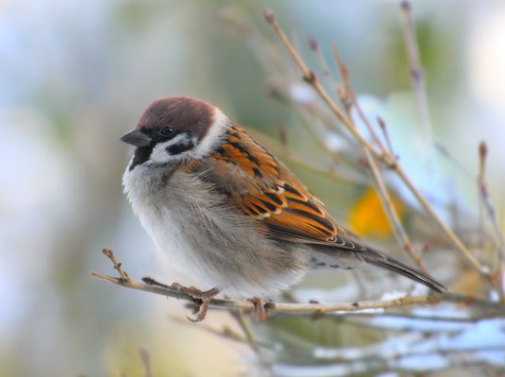
Solitary sparrow
It has long wings, a short and square tail, a slightly curved conical beak at the tip, and legs with long toes and very developed claws.
It is a cheerful and lively bird, very agile and quick both in running and in flight. FULL PROFILE >>
The blue rock thrush (Monticola solitarius) reaches a length of 23 cm and the male has a uniform slate-blue plumage, with black beak and feet. The female, although tending towards blue, is brown with gray bars and spots.
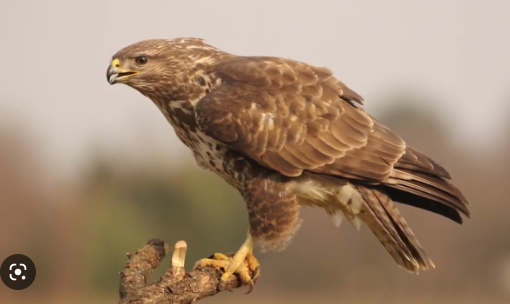
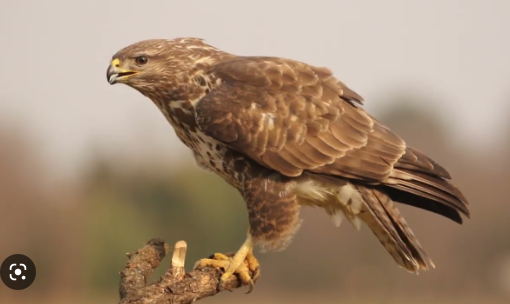
Poiana
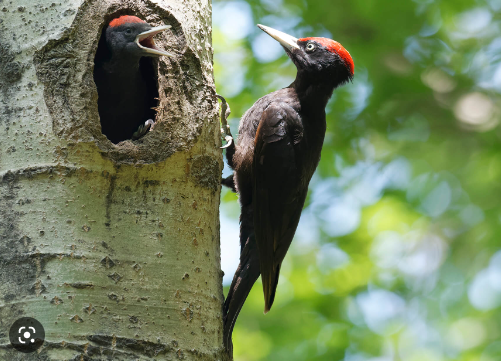
Black woodpecker
The black woodpecker (Dryocopus martius), the largest of the European woodpeckers, is as big as a crow and is almost 50 cm long, with a wingspan that can reach up to 68 cm. It is uniformly black, except for a red area that in the male covers the entire top of the head.
The black woodpecker is cheerful, shy, agile, and robust, always hopping and covering its entire domain in a very short time.
In flight it is slower than other woodpeckers, but it can cover more than two kilometers in a single trip. On the ground it is uncomfortable and only manages to hop awkwardly, but it remains the best climber among all European woodpeckers, and excels in the art of hammering tree bark with its beak. COMPLETE FACT SHEET >>
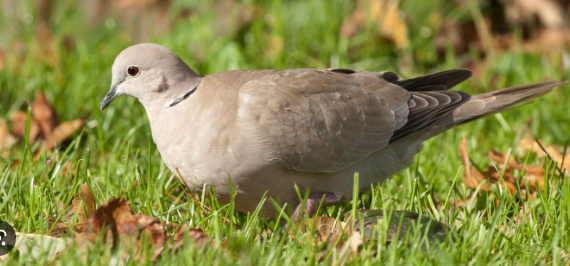
Tortora
Sparrowhawk
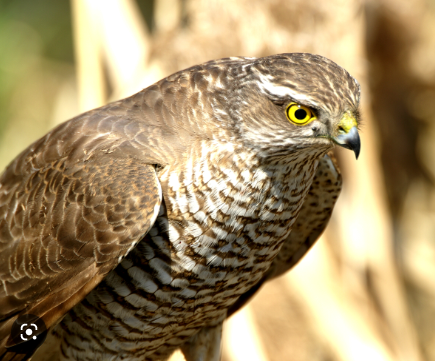
The sparrowhawk (Accipiter nisus) is about 35 cm long with a wingspan that does not exceed 80 cm. Females are similar to males in terms of plumage, but differ in their significantly larger size. The curved beak is not a weapon, but a tool with which the raptor breaks and shreds the captured animal. COMPLETE FACT SHEET >>
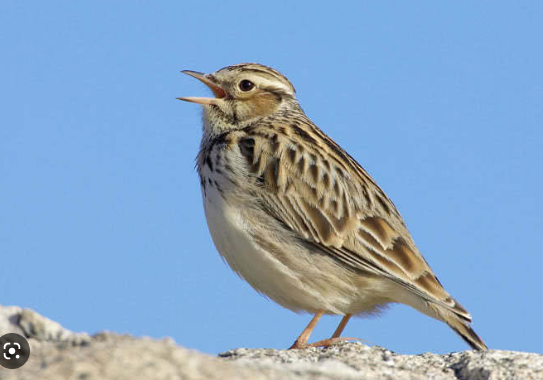
Tottavilla
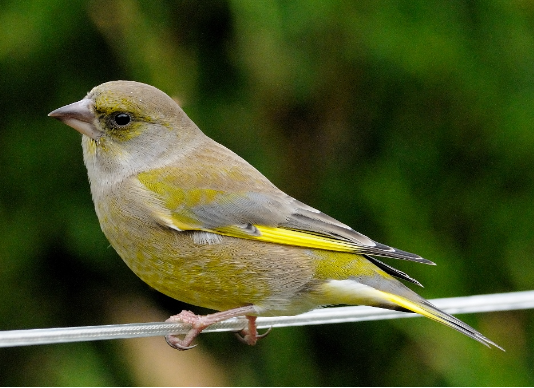
Verdone
The woodlark (Lullula arborea) reaches a length of about 15 cm and a weight of 27 grams, with a very short tail and plumage on the upper part that is tawny-brown with black streaks and white eyebrows, while the lower part is white. The wings have a characteristic black and white spot on the edge.
It is an agile bird and quick in its movements, runs fast on the ground and its name (woodlark) derives from the fact that it does not only perch on the ground, like related species, but also on trees.
Its song is delightful and for this reason it is sought after by enthusiasts. COMPLETE FACT SHEET >>
The female has a slightly less vivid color and the yellow is less widespread or absent. The young are like the female, but clearly streaked with brown on the upper parts; rump brown streaked; underparts more gray-yellowish, streaked with brown; wing coverts brown. Tip of the beak brown and legs dark flesh-colored. Complete molt between the end of July and September. In spring, the green and yellow are more vivid.
The body is rather stocky. The song is strong and pleasant, even if not highly valued. The main call is a chiip or chiic almost always repeated in rapid series, especially in flight, with numerous variations in rhythm and tone.
The flight is undulating. It does not stray far from the trees. The male attracts the female by hopping, raising one wing, with the head upright, beak open, and tail spread like a fan. COMPLETE FACT SHEET >>
The Greenfinch (Chloris chloris) is about 15 cm long, and owes its name to the coloration of its plumage, which shows various shades of green. The upper parts are olive green, throat and breast yellow-green, belly golden yellow, as well as the outer base of the primary flight feathers and tail feathers.
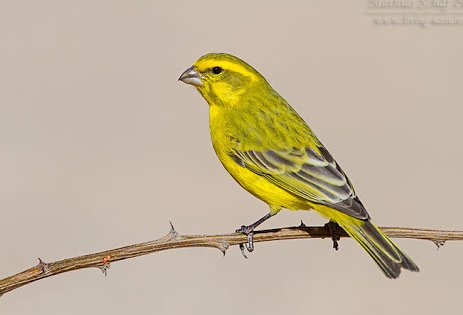
Verzellino
The beak is horn-colored, paler towards the lower mandible, the legs are dark brown, and the iris is brown-black. The female is like the male, but less yellow and more streaked on the chest and head, and has a paler rump. The young have reddish upper parts, streaked with dark brown, a pale streaked rump, reddish underparts streaked with brown except for the belly and chin.
The song, more than melodious, is fresh, pleasant, and chirping in flight.
It can live with other birds towards which it is quite sociable.
.The Serin (Serinus canarius serinus) is a small bird about 11.5 cm long, with yellow-greenish forehead and nape streaked with brown-black, yellow eyebrow, brown-yellowish mantle streaked with brown-black, as is the yellow back; yellow-greenish rump, yellow-greenish underparts, streaked with brown on the sides; whitish belly, flight and tail feathers brown-black edged with greenish, wing coverts with light spots.
©BabbaroHouse